[Print version] (MS-Word)
 |
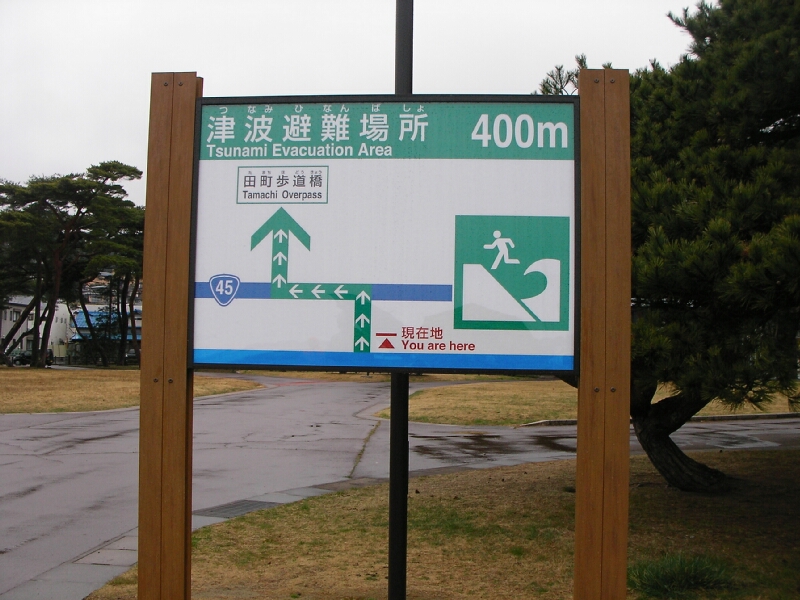
| A sign showing the tsunami evacuation area (Matsushima Town) |
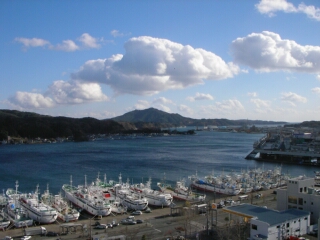 |
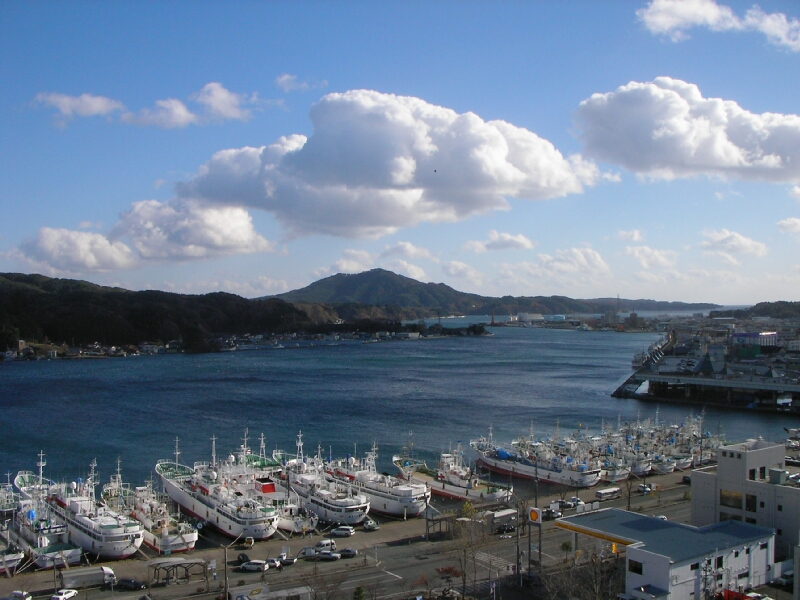
| One of the main fishery cities in the Sanriku coast (Kesennuma City) |
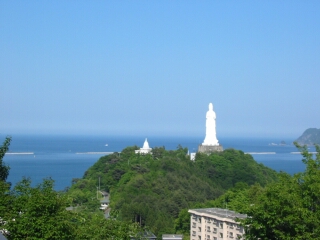 |
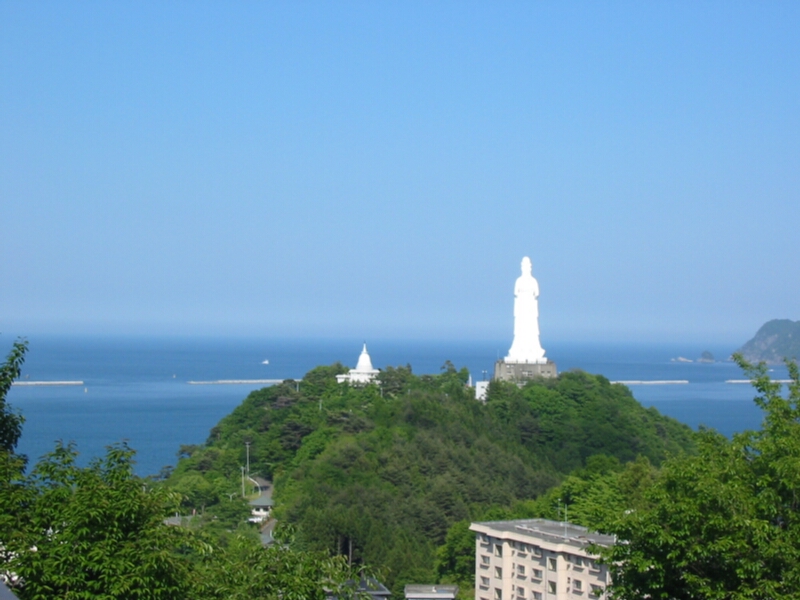
| The statue of the Kannon Goddess (48.5-m-high sightseeing spot of Kamaishi City) and tsunami seawall installed in the Kamaishi Bay entrance |
Theme:
Structural and non-structural countermeasures in tsunami-threatened areas in Sanriku
Leaders:
- Fumihiko Imamura (Tohoku Univ.)
- Ikuo Abe (Tohoku Univ.)
Key Words:
- The 1896 Meiji Sanriku Earthquake Tsunami
- The 1960 Chilean Earthquake Tsunami
Related Topics:
- Structural and Non-structural Countermeasures
- Disaster Education
- Remote Sensing
- Bathymetric Change
Description:
Area of the Sanriku coast facing the subduction zone has suffered from large tsunami disasters such as the 1896 Meiji Sanriku,
the 1933 Showa Sanriku, and the 1960 Chilean tsunamis. In particular, the 1896 Meiji tsunami with waves higher than 10 m struck
one stretch of the coast, recording a maximum runup of 38 m and causing more than 22,000 deaths. At present, various structural
and non-structural countermeasures against tsunami disasters are implemented in the Sanriku areas to reduce and prevent such damage.
This field trip is a planned visit to learn the history of the event and observe countermeasures such as those listed below.
- Tsunami evacuation in the sightseeing areas damaged by the 1960 Chilean Tsunami
- Countermeasures in the fishing city, such as development of disaster-prevention maps and evacuation areas
- Kesennuma Bay: bathymetric changes attributable to sediment transport by the 1960 Chilean Tsunami
- Seawall installed at the entrance of Kamaishi Bay: its basement is 63 m deep (world's deepest seawall)
- GPS swell meter for early tsunami detection and warning
Maximum number of participants: 50 persons
Costs: 25,000 JPY (including accommodation (1 night), 2 lunches (12−13 April), 1 dinner (12 April), bus, ship, admission to the tsunami museum, field guide)
Schedule:
- 12 April: Leaving Sendai early morning
- Matsushima or Minami-Sanriku (Tsunami evacuation in the sightseeing areas and the fishing city)
- Kesennuma (Tsunami museum and Kesennuma Bay to study the bathymetric change in the inner bay)
- Stay at Kesennuma
- 13 April: Field trip and arrival at Sendai
- Oofunato (Maximum runup of 38 m)
- Kamaishi (Seawall installed in the entrance of Kamaishi Bay; we will inspect it on a ship)
- Arrive at Sendai by bus (via Shin-Hanamaki Station; Tohoku Shinkansen)
Note:
- Accommodations are a Western-style room or a Japanese-style room. Availability of Western-style rooms is limited.
- We will return to Sendai by bus via Shin-Hanamaki Station. Participants who want to go to Tokyo on 13 April can use the Shinkansen Super-express at Shin-Hanamaki Station (in this case, the Shinkansen cost is not included in the fee).
- Participants who will also join the Okinawa field trip will use the Shinkansen Super-express from Shin-Hanamaki Station to Tokyo Station, and will stay at the hotel near Haneda Airport. For them, Shinkansen tickets and the accommodation are included in the Okinawa field trip fee.
- April monthly average, highest, and lowest temperatures in Kamaishi are, respectively, 9.2, 14.1 and 4.2 °C.